
CV Writing for Job Applications in the UK: 2026 Guide
Your CV is the first thing most employers see. It decides whether you get an interview or not. Many applicants lose opportunities not because they lack the right experience, but because their CV is unclear, inconsistent, or written for the wrong audience.
This guide covers how to write a strong UK CV in 2026. It explains structure, formatting, ATS systems, common mistakes, and the practical differences between a weak and a strong CV. It is relevant for graduates, career changers, and experienced workers.
What Makes a UK CV Work
Recruiters typically spend between six and ten seconds scanning a CV before deciding whether to read it properly.
That figure comes up consistently in recruiter surveys and it shapes every decision you should make about layout, length, and content.
A CV that works in the UK is clear, honest, and tailored to the specific role. It is not a list of everything you have ever done. It is a curated argument for why you are the right person for one particular job.
CV Versus Resume: What UK Applicants Need to Know
CV stands for curriculum vitae. In the UK, Ireland, and most of Europe, this is the standard document for job applications at every level. In the US and Canada, the equivalent is called a resume.
The practical differences matter if you are reading advice online, since much of what appears in search results is written for an American audience and does not apply here.
UK CVs typically run to one or two pages. US resumes usually stay on one. UK CVs do not include a photograph, date of birth, marital status, or nationality.
These details are not expected by UK employers and can introduce bias into the process. UK CVs use British English spelling throughout.
If you are applying for roles in the UK, follow UK conventions. Advice written for a US audience will steer you wrong on several of these points.
What to Include: The Core Sections
Most professional UK CVs follow the same structure. Recruiters expect this order because it speeds up their assessment.
Contact details. Your full name, a phone number, a professional email address, and a link to your LinkedIn profile if it is current. Your city or region is enough for location. You do not need your full home address.
Personal statement. Two to four lines directly beneath your contact details. Summarise who you are, what you offer, and the kind of role you are seeking. This is the section recruiters read most carefully at the start, so it needs to sound specific to the job, not generic.
Weak: Hardworking individual seeking opportunities to develop skills and contribute to a successful organisation.
Strong: Customer Service Assistant with three years of retail experience in high-volume environments. Skilled in complaint resolution, team collaboration, and sales support. Seeking a customer-facing role within a growing UK organisation.
Key skills. Six to ten bullet points that mirror the language in the job advert. This section helps both human recruiters and automated screening systems identify your suitability quickly.
Work experience. List roles in reverse chronological order, most recent first. For each role include your job title, the employer name, and the dates. Add two or three bullet points per role focused on outcomes rather than duties.
Weak: Responsible for managing a team.
Strong: Led a team of six across two sites, reducing average complaint resolution time from four days to one.
The difference is impact. Outcomes with numbers attached are consistently more persuasive than descriptions of responsibilities.
Education and qualifications. List your highest or most relevant qualifications first, including the institution name and year of completion. Graduates and early-career candidates should place this section higher up. Experienced candidates can move it below work experience.
Optional sections. Certifications, relevant training, language skills, and voluntary work all add value when they are genuinely relevant. Do not include them to fill space.
Choosing the Right Format
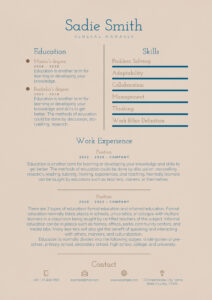
Three CV formats are commonly discussed. In practice, one suits the vast majority of UK applicants.
Reverse chronological lists your most recent role first and works backwards. This is the standard format in the UK. Recruiters find it easiest to scan and ATS systems handle it most reliably. Use this unless you have a specific reason not to.
Functional or skills-based formats lead with skills rather than employment history. Some career changers use this to draw attention away from gaps or limited experience.
The problem is that recruiters recognise this intention and sometimes read it as an attempt to obscure something. Only use a functional format if a recruiter has specifically suggested it.
Combination or hybrid formats blend skills with employment history. They take longer to write well and are worth considering only if you have strong relevant skills alongside a varied work history that supports them.
For most people, reverse chronological is the right choice.
How ATS Systems Work and What They Actually Miss
Many employers use Applicant Tracking Systems to process applications before a human recruiter sees them. Understanding how these systems work prevents your CV from being filtered out before anyone reads it.
An ATS reads your CV, sorts the content into recognisable sections such as work history and skills, and then scans for keywords and phrases pulled from the job description.
CVs that match more closely receive a higher ranking. Lower-ranking CVs may never reach a human reader at all.
The practical implication is straightforward. Use the exact language from the job advert wherever it accurately reflects your experience.
If the advert says stakeholder management and you have been writing client relationships, the ATS may not connect them as equivalent. One phrase scores. The other does not.
What ATS systems are genuinely bad at is nuance. A system cannot assess your judgement, your communication style, or whether your achievements are impressive in context. It can only match text.
This means a CV that scores well with an ATS is not necessarily the strongest CV overall. It is simply the one most likely to reach a human reader who can make that broader assessment.
Keep your formatting simple for ATS purposes. Avoid tables, columns, text boxes, images, and unusual fonts within the CV document itself. Use a clean single-column layout with standard heading labels.
Save in the format the employer requests, either Word or PDF. Some older ATS systems still struggle to parse PDFs accurately, so check the job advert for guidance.
Keyword stuffing does not work and often backfires. Many modern systems flag unnatural repetition and a human recruiter will notice it too.
Common Mistakes That Cost Interviews
These patterns appear consistently across CVs that do not get through.
Listing duties instead of achievements. Describing what your job involved tells a recruiter very little. What changed, improved, or resulted directly from your work is what matters.
Sending the same CV to every application. A generic CV rarely performs as well as one tailored to the specific advert. The tailoring does not need to be extensive. Adjusting your personal statement and mirroring key language from the advert is often enough.
Overcrowding the page. A CV that includes everything dilutes the genuinely impressive parts. Be selective.
Skipping proofreading. Spelling and grammar errors signal a lack of attention to detail. Read the document aloud or ask someone else to check it before you submit.
Using pronouns. UK CVs conventionally avoid I, my, and me. Instead of I managed a team of five, write Managed a team of five, cutting delivery time by 20 percent.
Including personal information. Leave out marital status, nationality, date of birth, and photographs. UK employers do not need these and in some cases including them can work against you.
Forgetting to update contact details. Outdated phone numbers and unused email addresses appear more often than you would expect.
How to Tailor Your CV Without Starting from Scratch
Tailoring means adjusting your CV so it speaks directly to the specific job advert in front of you. It does not mean rewriting the whole document every time.
Read the job description and note any skills, tools, or qualifications that appear more than once.
These signal what the employer prioritises. Then adjust three things: your personal statement, your skills section, and the bullet points in your most recent roles.
Make sure the most relevant matches are visible without a recruiter having to search for them.
This takes an extra twenty minutes per application. It consistently produces better results than submitting the same document everywhere.
Tailoring does not mean exaggerating. Interviewers probe anything on your CV. Misrepresenting your experience creates problems that surface at interview or after you start the role.
Length, Layout, and Presentation
Most UK CVs should be one to two pages of A4. Graduates or those early in their career can usually fit their information onto one page. Experienced professionals may need the full two pages.
Academic or research CVs are an exception since publications and projects can extend them further.
For layout, use a clear professional font such as Arial, Calibri, or Georgia at size 11 or larger. Keep headings consistent throughout.
Use bullet points rather than paragraphs. Leave enough white space between sections that the document is easy to scan.
Avoid colour, graphics, and decorative borders. A clean, well-organised CV communicates professionalism before a recruiter reads a single word.
Cover Letters: When They Matter
Not every employer requests a cover letter. Where one is expected or marked optional, a short tailored version strengthens your application.
Use it to explain your motivation for the specific role and expand on one achievement from your CV that is particularly relevant.
A cover letter that simply restates your CV adds nothing. Where you write one, treat it as a companion piece that adds context rather than a duplicate.
Quick Checklist Before You Submit

Contact details are current and professional. Personal statement is tailored to the specific role. Key skills mirror language from the job advert where accurate.
Work experience bullet points focus on outcomes, not duties. No spelling, grammar, or formatting inconsistencies remain. Personal details such as age, marital status, and nationality are not included.
File is saved in the requested format with a clear professional file name. CV length sits within one to two pages unless your field expects otherwise.
Frequently Asked Questions
How long should a UK CV be? One to two pages. Graduates can often manage one. Experienced professionals may need two.
Should I include a photo? No. Photos are not expected on UK CVs.
What is the best format for UK jobs? Reverse chronological is the most widely used and recruiter-friendly format in the UK.
Do employers use ATS software? Yes. Most large employers and many mid-sized ones use some form of ATS to screen applications before they reach a recruiter.
How often should I update my CV? Update it whenever you gain new experience, qualifications, or significant achievements. Do not wait until you urgently need it.
Do I need to list references? No. Write references available on request and provide details only when an employer asks. Never include a referee’s contact information without their prior agreement.
Final Thoughts
Strong CV writing comes down to three things: clarity, relevance, and tailoring. A recruiter who is short on time needs to understand within seconds who you are and why you are suitable for the role.
Avoid relying on a single generic document for every application. Each small adjustment genuinely adds up. A sharper personal statement or a more specific achievement can shift how a recruiter reads your entire CV.
Update your CV gradually as your career develops rather than rewriting everything in a rush when you need it urgently. A document built steadily over time is nearly always stronger than one assembled under pressure.
This article is intended for general guidance and does not guarantee specific outcomes. Individual results vary depending on experience, sector, and the requirements of each employer.